
FEN Grammatik
German grammar in a book.
The German grammar course as a textbook, for students and independent learners.
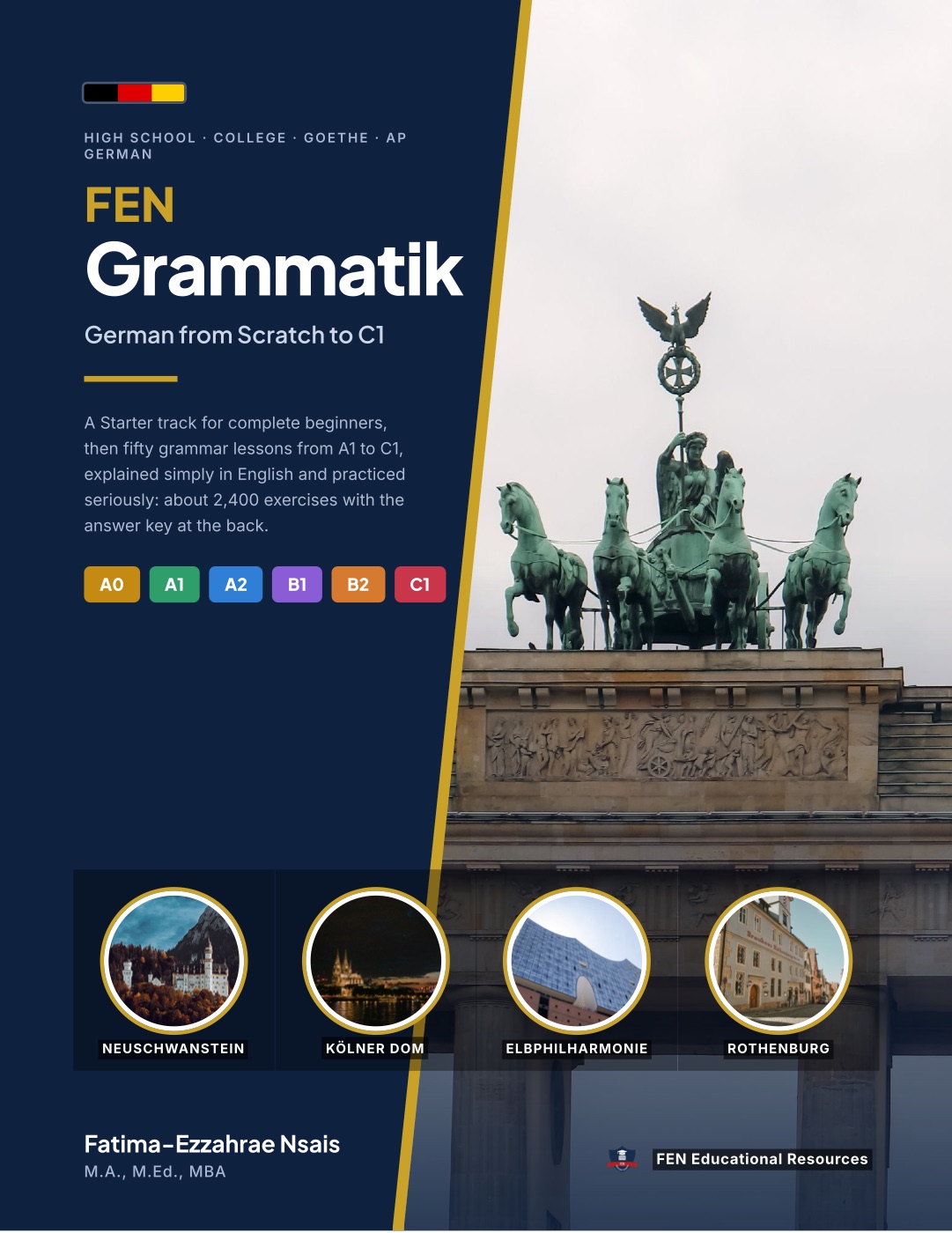
FEN GrammatikGerman from Scratch to C1
Table of contents
Placement test
A0 Start from zero
- The alphabet and spelling your name
- Pronunciation: ä, ö, ü, ß, ch, sch, ei and ie
- Hello and goodbye: greetings, please and thank you
- Introducing yourself: name, country, city, languages
- Survival phrases: I do not understand, please repeat, how do you say
- Numbers from 0 to 100
- Big numbers, prices, phone numbers and years
- Telling the time
- Days, months, seasons and the date
- Family and people: mein, dein, Ihr
- Colors, everyday objects and Was ist das?
- Body, health and a visit to the doctor
- Food and drink: at the bakery and the café
- Shopping: the supermarket, prices and the Pfand
- In town: places and asking the way
- Trains, buses and tickets
- The weather and small talk
- Finding a home: the WG, Kaltmiete and the Hausordnung
- Paperwork: the Anmeldung, forms and appointments
- Everyday culture: Sie and du, punctuality, Sunday rest and recycling
- End-of-level exam A0
A1 Beginner
- Sein and haben in the present tense
- Gender and the articles: der, die, das, ein, eine
- The present tense of regular verbs
- The present tense of stem-changing verbs: fahren, sehen, nehmen
- Word order: the verb in second position, and questions
- The accusative: den, einen, and the direct object
- Negation: nicht and kein
- The plural of nouns
- Possessive articles: mein, dein, sein, ihr, unser
- Modal verbs: können, müssen, wollen, möchten, dürfen, sollen
- End-of-level exam A1
A2 Elementary
- Separable and inseparable verbs
- The dative: the indirect object and dative verbs
- Personal pronouns in the nominative, accusative and dative
- Prepositions with the accusative or the dative
- Two-way prepositions: wo or wohin?
- The Perfekt with haben and the past participle
- The Perfekt with sein: haben or sein?
- The Präteritum of sein, haben and the modal verbs
- The imperative
- The comparative and the superlative
- End-of-level exam A2
B1 Intermediate
- Subordinate clauses: weil, dass, wenn, ob
- Reflexive verbs
- Adjective endings
- The Präteritum of regular and irregular verbs
- Relative clauses: der, die, das
- The genitive and its prepositions: wegen, trotz, während
- The Futur I and the verb werden
- Konjunktiv II: würde, wäre, hätte, könnte
- The infinitive with zu: um... zu, ohne... zu, statt... zu
- The passive in the present and the Präteritum
- End-of-level exam B1
B2 Upper intermediate
- The Plusquamperfekt and time clauses: nachdem, bevor, als, während
- Konjunktiv II in the past: unreal conditions and regrets
- The passive in every tense, with modal verbs, and the Zustandspassiv
- Indirect speech and Konjunktiv I
- Relative clauses with prepositions, dessen, deren, was and wo
- Verbs with prepositions: worauf, darauf, auf wen
- The n-declension and adjectives used as nouns
- Concession and contrast: obwohl, trotzdem, während, dagegen
- Two-part connectors: sowohl... als auch, weder... noch, je... desto
- Purpose and consequence: damit, um... zu, sodass, deshalb
- End-of-level exam B2
C1 Advanced
- Extended participial attributes
- Nominal style: nominalization and verbalization
- Funktionsverbgefüge: in Frage stellen, zur Verfügung stehen
- The subjective use of modal verbs: er soll, sie dürfte, es muss
- Konjunktiv I in the press and unreal comparisons with als ob
- The Futur II and expressing assumptions
- Word order in the middle field: time, cause, manner, place
- Modal particles: doch, ja, mal, eben, halt, wohl
- Passive substitutes and the gerundive: sein + zu, sich lassen, -bar
- Connectors for argumentation: indem, sofern, zumal, folglich, hingegen
- End-of-level exam C1
Exam practice6 entries
- Goethe B1 · Set 1: Everyday life and travel
- Goethe B1 · Set 2: Work, school and media
- Goethe B2 · Set 1: Society, environment and science
- Goethe B2 · Set 2: Work, studies and media
- AP German · Set 1: Family, community and everyday life
- AP German · Set 2: Global challenges, technology and the arts
Reading
- A1: Beginner
- A2: Elementary
- B1: Intermediate
- B2: Upper intermediate
- C1: Advanced
Answer key
Glossary
E-book
Just the e-book
$39.99
- Full-color PDF, licensed to you
- Reads on any phone, tablet or computer
- Download link the moment you pay
E-book bundle
Grammatik + Konjugation
$49.99 save $4.99
- Both full-color PDFs, licensed to you
- The course book and the verb reference together
- Download links the moment you pay
Paperback · pre-order
Just the book
Price at launch
- Reserve now, pay only when it is ready to ship
- Cancel any time before it ships
- Printed on demand
Looking for the online course? See the course.